

Finishing · April 13, 2026 · 6 min read
Cerakote vs. Electro-Bluing: Choosing the Right Finish for Your Pistol
By Jo Shaiiia
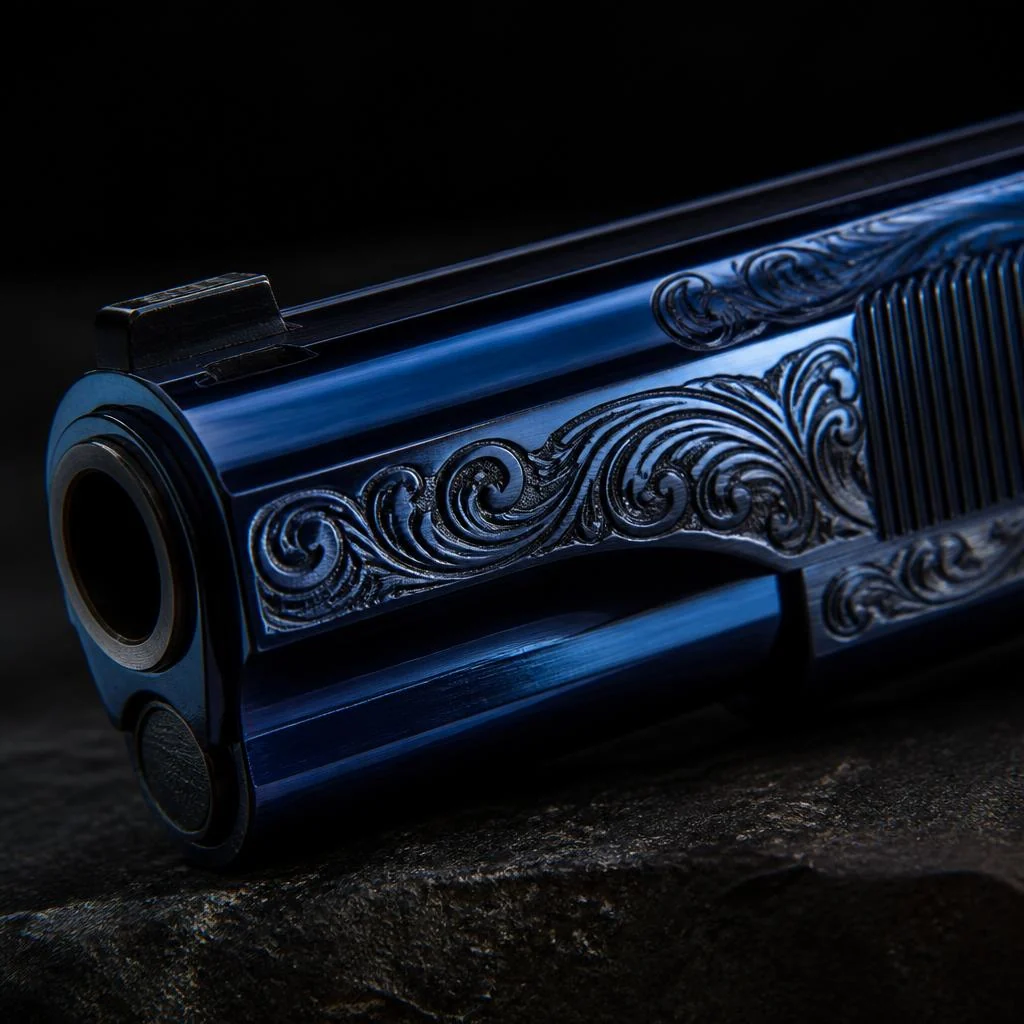
Every week someone asks us the same question in slightly different words: should I Cerakote it or blue it? The honest answer is that these are not two grades of the same thing. They are two different ideas about what a finish is for.
What bluing actually is
Bluing is not a coating. It is a controlled conversion of the surface of the steel itself into a thin layer of black iron oxide. Done properly — the parts polished to a high lustre first, then immersed in a hot salt bath — the result is that deep, glassy blue-black that has defined fine firearms for over a century. Light does not sit on top of a blued surface; it sinks into it.
Because it is only a few microns deep, bluing offers modest corrosion resistance. It relies on oil. A blued pistol that is wiped down and kept dry will look magnificent for decades; one left in a damp case will not. The finish is honest that way. It rewards care and punishes neglect.
What Cerakote actually is
Cerakote is a ceramic-polymer thin-film coating. The part is media-blasted to a uniform matte texture, degreased, masked, sprayed and then oven-cured. What results is a hard, chemically bonded skin roughly 25 microns thick that resists abrasion, solvents, sweat and salt far better than any traditional finish.
It is available in matte, satin and gloss, in a broad palette, and it does not need oil to survive. A Cerakote slide can be carried daily, holstered, rained on and cleaned with harsh solvents without visible change. It is, in the truest sense, armour.
Where each belongs
We reach for bluing when the piece is about depth: a hand-engraved 1911, a sidelock shotgun, a revolver whose lines deserve a finish that behaves like polished stone. Bluing over hand-cut engraving is a combination that has never been improved upon. Every cut holds a shadow; every flat holds a reflection.
We reach for Cerakote when the piece is about use or colour: a carry pistol, a rifle that will live in a truck, a project where the client wants Flat Dark Earth, olive, or a two-tone composition that steel simply cannot give. It is also the base for laser imaging, which only works because the ceramic layer can be precisely removed.
Can they be combined?
Yes, and often should be. A common atelier composition is a blued or gold-plated slide over a Cerakoted frame — the reflective element where the eye lands, the durable element where the hand lives. What we avoid is Cerakote over fine engraving, where the film softens the crispness of the cut. If a piece is engraved, we finish it in blue, gold or chrome, or leave it in the white.
A practical way to decide
Ask what the piece is for. If it will be admired more than it is carried, blue it. If it will be carried more than it is admired, Cerakote it. If it will be both — and the best pieces usually are — let us build it so each surface gets the finish it deserves.
Related services
Continue reading
Begin a piece of your own.
Begin a Bespoke Project