

Gunsmithing · May 11, 2026 · 6 min read
What an Optic Cut Actually Involves (RMR, RMSc, ACRO, 509T)
By Jo Shaiiia
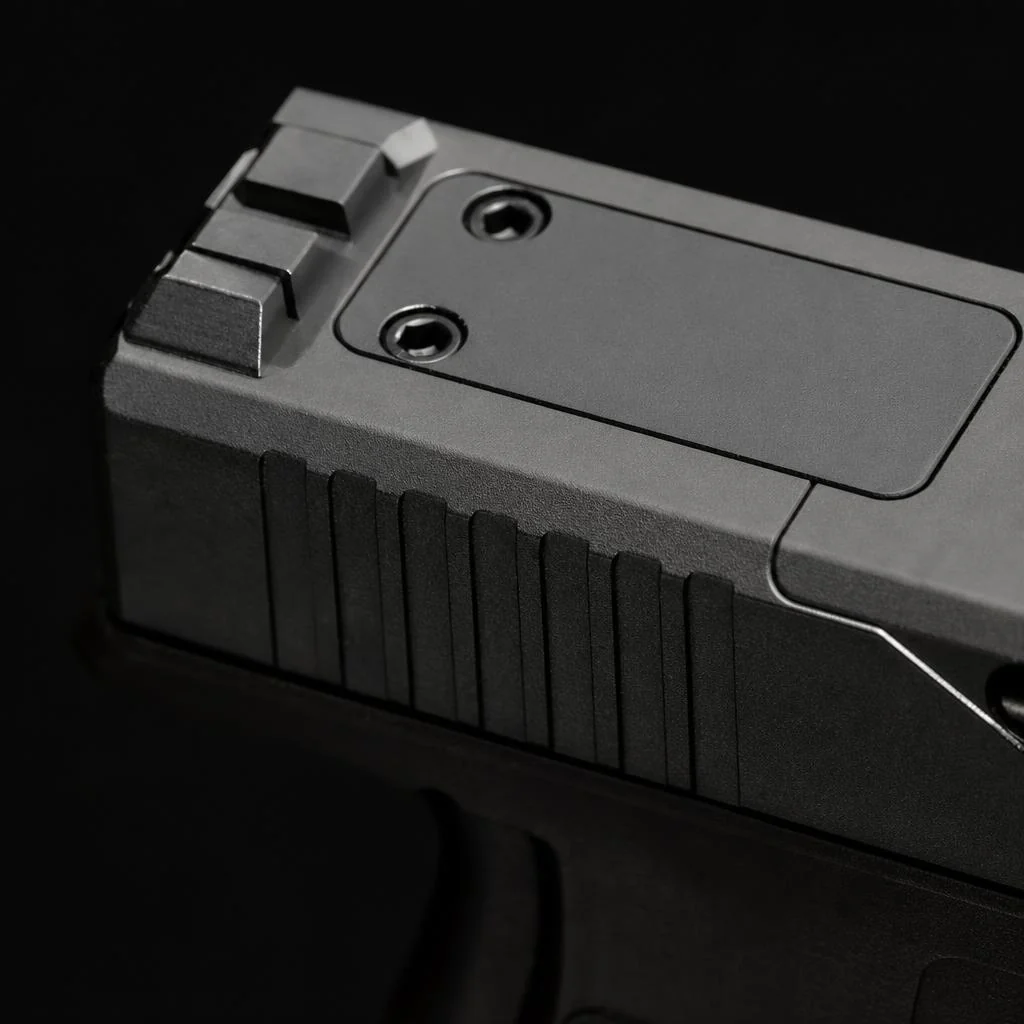
A red dot on a pistol is no longer unusual. What is still unusual is a cut done properly — one that sits the optic low, holds zero, and looks as though the slide left the factory that way. Here is what the process involves when it is done with care.
Footprint first
Every optic family has a footprint: a specific pattern of screw holes, recoil bosses and pocket dimensions. The common ones we mill are Trijicon RMR, Shield RMSc (which also covers Holosun 407K/507K and similar), Aimpoint ACRO, Holosun 509T, and Leupold DeltaPoint Pro. They are not interchangeable. An RMR pocket will not accept an ACRO, and an "adapter plate" solution always raises the optic and adds a failure point.
So the first question is not which pistol but which optic. Choose the optic, then we cut for it exactly.
Milling the pocket
The slide is fixtured on a multi-axis CNC and the pocket is milled to the footprint's depth, with the rear wall and recoil bosses machined as part of the same operation so the optic locks against steel, not just screws. Tolerances here are measured in hundredths of a millimetre. Too shallow and the optic sits proud; too deep and the slide is weakened over the striker channel. The threaded holes are tapped to the optic's screw specification, not to whatever is convenient.
The details that separate good from correct
- Iron sight height. A low-mounted optic is often too low for the factory irons to co-witness. We advise on suppressor-height sights or a rear-sight integration in the same cut.
- Cover plate. Every cut leaves with a matched cover plate, machined from the same stock and finished identically, so the pistol is complete with or without the optic.
- Deburring. Every edge is broken by hand. A sharp corner on the pocket is a stress riser and, eventually, a crack.
- Refinishing. Milling removes the finish. The slide is then refinished — Cerakote, bluing, or matched to the existing colour — so there is no raw steel and no visible transition. This is the step most often skipped elsewhere.
Combining with other work
An optic cut is a natural moment to consider the rest of the slide. Lightening windows, serrations and ports are all milled in the same fixturing, which keeps everything in alignment and is more economical than returning for each separately. Engraving is planned around the optic footprint so that no scroll is later covered by the housing.
What to send
The complete slide, with the optic if you already own it. We test-fit before anything leaves the bench and pressure-test the slide before it is refinished. Turnaround for a cut alone is short; combined with finishing and other work it joins the project timeline.
Related services
Porting & Optic Cuts
Compensating ports, top windows, lightening cuts and optic milling on multi-axis CNC. Every cut is deburred, refinished and function-tested.
Cerakote
Thin-film ceramic coating for slides, frames and receivers. Media-blasted, masked, sprayed and heat-cured for abrasion and corrosion resistance.
Begin a piece of your own.
Begin a Bespoke Project