Engraving · April 27, 2026 · 7 min read
Arabic Calligraphy on Firearms: Diwani, Thuluth and Kufic in Steel
By Jo Shaiiia
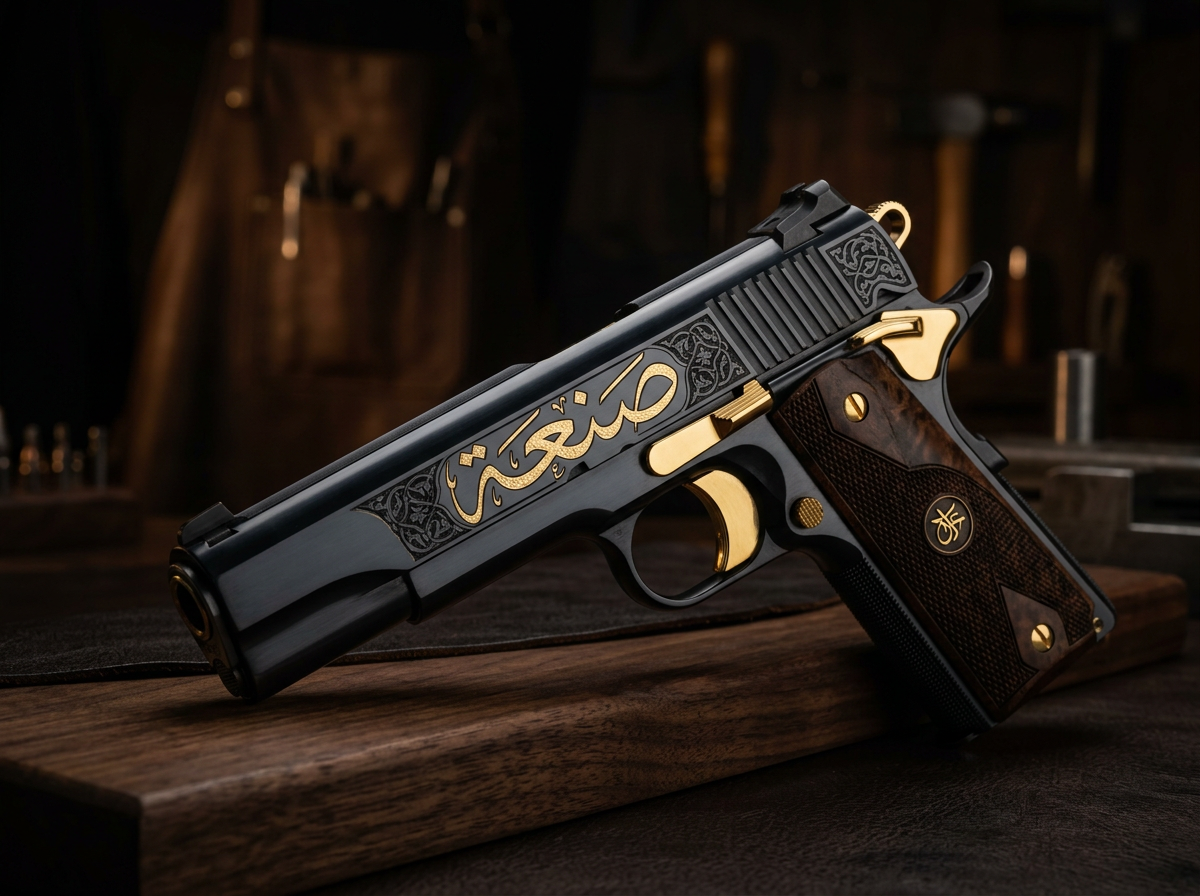
Arabic calligraphy is a discipline of the reed pen. Its beauty lives in the thick-and-thin of a stroke, the way a letter swells and tapers as the nib turns. Steel does not swell or taper. It is cut, and a cut is only as expressive as the graver that made it. Translating one into the other is, for us, some of the most demanding work in the house.
Choosing the script
The three scripts we are most often asked for behave very differently under the graver.
Diwani is the most ornamental — fluid, compressed, letters stacked and interlocked. It suits a signature, a name, a short blessing, and it fills a small panel beautifully. It is also the least forgiving: a Diwani composition that is a millimetre out of balance reads as clumsy immediately.
Thuluth is monumental. Tall verticals, generous curves, a rhythm meant to be read from across a room. On a firearm it works best along a slide flat or a shotgun rib, where the eye travels in a line. It is the script we recommend for verses.
Kufic, in its geometric form, is the natural friend of metalwork. Square Kufic in particular is built on a grid, and a grid is what a machine and a hand both understand. It lends itself to borders, to backstraps, to the frame of a magazine well — anywhere a pattern should repeat with authority.
From pen to layout
Every calligraphic project at the atelier begins on paper. The composition is written by hand, several times, until the weight is right. Only then is it scanned, refined, and scaled to the exact surface of the part — because a phrase that balances on an A4 sheet will not balance on a 22 mm-wide slide without adjustment. Ascenders are shortened, counters opened, the baseline bent to follow a curve.
The refined drawing is then cut into the metal by fibre laser, with the depth built in layered passes so the letters have a floor rather than a scratch. From there the work returns to the bench, where the strokes are shaped under a loupe — flared at the entry, tapered at the exit — in the way a reed would have made them. You can read more about how we divide the work in our note on hand engraving versus laser.
Finishing the letters
Calligraphy in steel wants contrast. Left bright in a blued slide, the letters glow. Filled with 24K gold against a black Cerakote ground, they become jewellery. Deep relief, with the background stippled and the letters left proud and polished, gives the most sculptural result and is the one we recommend for Thuluth.
What we ask of the client
Bring the text with its diacritics as you want it to appear, and tell us who it is for. A verse for a father, a name for a son, a phrase carried into service — the purpose changes the script, the weight, the placement. It is not decoration. It is a message the piece will carry for a lifetime, and we treat it that way.
Related services
Custom Engraving
Full-coverage scrollwork, arabesque, bank-note and calligraphic engraving produced primarily by precision fiber laser, with hand finishing applied where the design calls for it.
Plating & Bluing
Full-immersion plating in 24K gold, rose gold, chrome and nickel, plus classical hot electro-bluing over hand-polished steel.
Continue reading
Begin a piece of your own.
Begin a Bespoke Project