Engraving · May 25, 2026 · 6 min read
Hand Engraving vs. Laser Engraving — and Why We Use Both
By Jo Shaiiia
Somewhere along the way "laser engraved" became a phrase people use with a slight wince, and "hand engraved" became a phrase people use as a guarantee. Neither reaction is quite fair. They are different tools, and a serious atelier uses each for what it does well.
What a laser does well
A fibre laser does two things extraordinarily. First, it marks: it can place a design on a surface with sub-millimetre accuracy, repeatably, on the exact curve of a cylinder or the exact flat of a slide. Second, it ablates: it can remove material in controlled layers, which is what makes Cerakote laser imaging possible and what allows a photograph, a crest or a topographic pattern to become part of a finish.
A single shallow pass is what most people picture when they hear "laser engraved": a uniform, slightly burnt groove with no depth and no bright face. That is not how we run the machine. Depth is built in layered passes, with the power, frequency and pass count tuned to the steel in front of us, so a border can be sunk deep enough to throw a real shadow and a scroll can be given a floor rather than a scratch.
What the hand does well
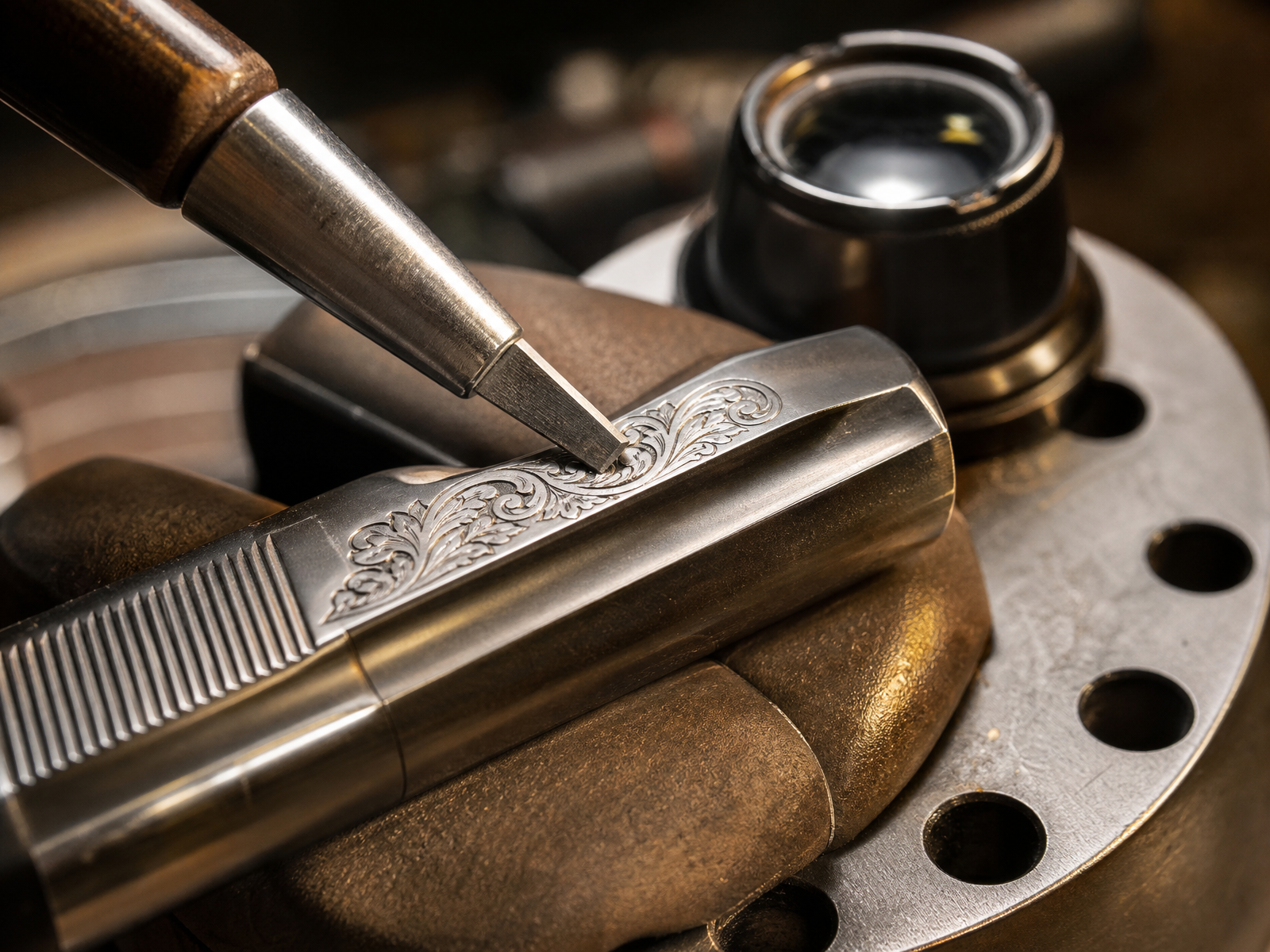
A hand graver, pushed or driven by a pneumatic handpiece, removes a sliver of metal and leaves a polished facet behind it. The depth and width of the cut change with the pressure of the hand. That is where scrollwork gets its life: the leaf that thickens as it curls, the shading lines that fade to nothing, the bright face that flashes as the piece is tilted. Bulino stippling, relief backgrounds, gold flush inlay and the stroke variation of Arabic calligraphy all belong to the hand, because they have to respond to the metal in the moment.
What the hand does poorly is repetition — keeping a border perfectly even around a curved receiver, or placing a client's crest at exactly the same scale on both sides of a slide.
How the two work together here
Our method gives each tool the job it is honestly better at. The design is drawn by hand and refined digitally. The primary cut is then made by fibre laser, with controlled depth and layered passes, so the geometry is exact and identical on both sides of the piece. From there the work returns to the bench: gravers are used for bright-cutting, shading, border definition, relief backgrounds and calligraphic detail wherever the design calls for it.
We describe it plainly because the combination is the point. The laser gives the client precision, consistency and repeatability — full-coverage patterns that align across a frame and slide, borders that do not wander, crests that match. The hand gives the piece what a machine cannot: life in the shading, crisp bright faces that catch raking light, and the swelling and tapering of a calligraphic stroke.
How to read a finished piece
Hold it in raking light and tilt it. The finished, hand-worked faces flash as the angle changes; the laid-in geometry beneath them stays true and even. A piece that has had no hand finishing at all reads flat and matte, and we will tell you when a design does not need any.
When laser alone is the right answer
For unit insignia on a magazine baseplate, a serial, a small logo on a leather holster, or imagery in Cerakote, laser work alone is correct and we say so. For a full-coverage commission that will be looked at closely for a lifetime, the graver comes out afterwards.
Related services
Custom Engraving
Full-coverage scrollwork, arabesque, bank-note and calligraphic engraving produced primarily by precision fiber laser, with hand finishing applied where the design calls for it.
Cerakote Laser Imaging
Fibre-laser ablation through a Cerakote layer, exposing the substrate beneath. Photographic detail that becomes part of the finish.
Continue reading
Begin a piece of your own.
Begin a Bespoke Project