

Photography · August 31, 2026 · 5 min read
Photographing a Firearm the Way You Would a Watch
By Jo Shaiiia
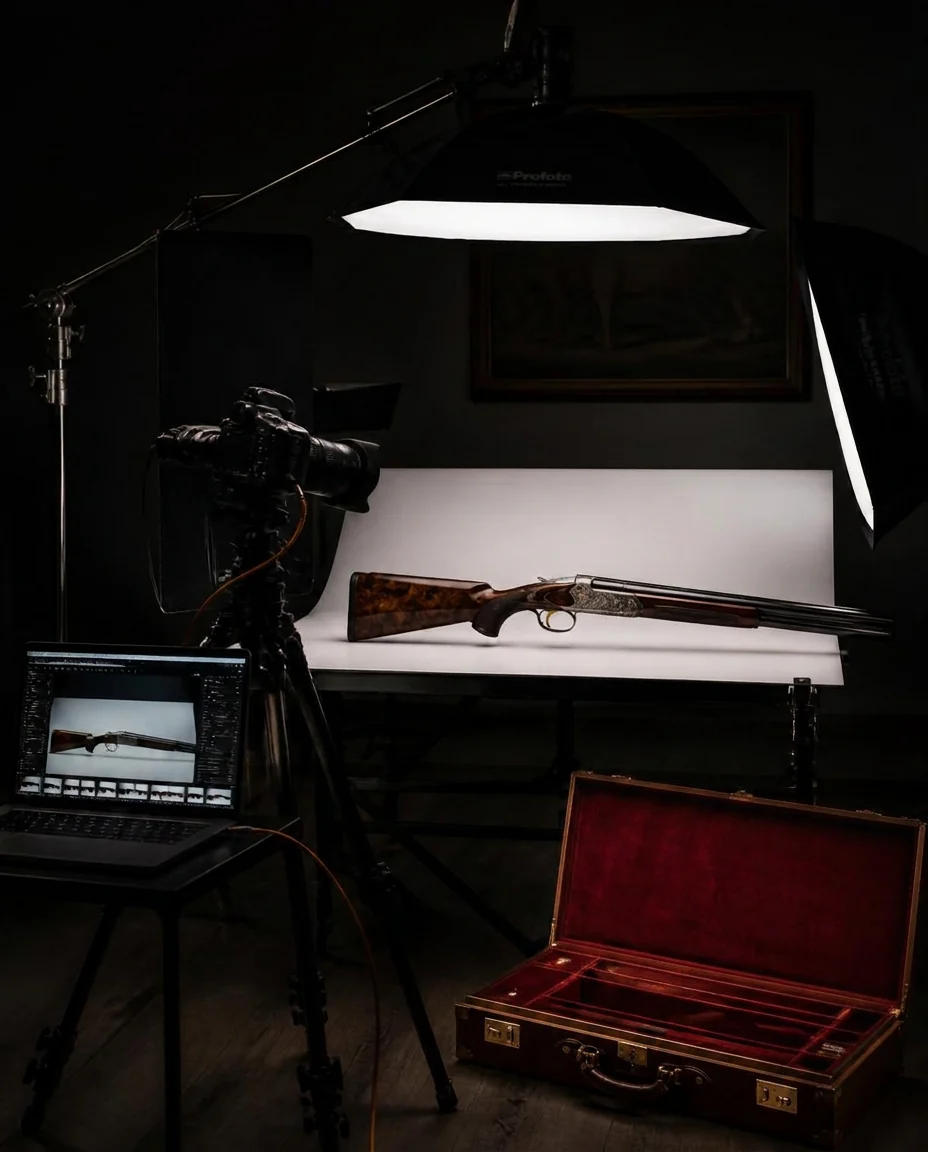
Before the atelier, I spent years photographing objects — jewellery, watches, things whose value lives in surfaces a few millimetres wide. When I began making firearms, it seemed obvious that they should be photographed the same way. Almost nobody was doing it.
Why it matters
A hand-engraved slide represents dozens of hours of work in an area the size of a playing card. Seen across a room, it is a pistol. Seen through a macro lens, at the right angle, in the right light, it is what it actually is. The photograph is how that work is seen — by the client, by the family that inherits the piece, by anyone who asks what it was.
Light
We use continuous light rather than flash, because engraving and plating are about reflection, and reflection has to be seen to be shaped. Large diffused sources define the flats; small hard sources raise the cut edges of scroll into relief; a gradient behind the piece gives a polished surface something to mirror. It is closer to lighting a watch dial than to product photography.
Surfaces
Black velvet, honed stone, dark oak, raw linen. Each piece is shot on the ground that suits it. A gold slide wants black; a blued shotgun wants warm wood; a Cerakoted rifle wants stone. The ground is part of the composition, never a backdrop.
What the client receives
- Hero compositions. The piece as a whole, in two or three arrangements.
- Macro details. Every engraved panel, inlay, texture and mark, at magnification.
- 360° turntable. A slow rotation, lit for the finish, so the piece can be seen from every side.
- Short-form video. Edited for social, if the client wishes to share it.
- Archival prints. On cotton rag, in the presentation case folder, with the full digital archive on a drive.
Photography as a service
We also photograph pieces we did not make — collections, historic firearms, pieces going to auction or insurance. The approach is the same: the object is treated as what it is, and the photograph is made to last as long as it will.
Related services
Continue reading
Begin a piece of your own.
Begin a Bespoke Project